Announcements
Signal Fire Radical Jewish Artist Coop Webstore, Now Live!
Our coop of incredible rad Jewish artists has officially launched its webstore! Head to signalfirecoop.org to checkout our zines, stickers, prints, and judaica! Stay tuned for the 5787 Radical Jewish Calendar, coming soon.
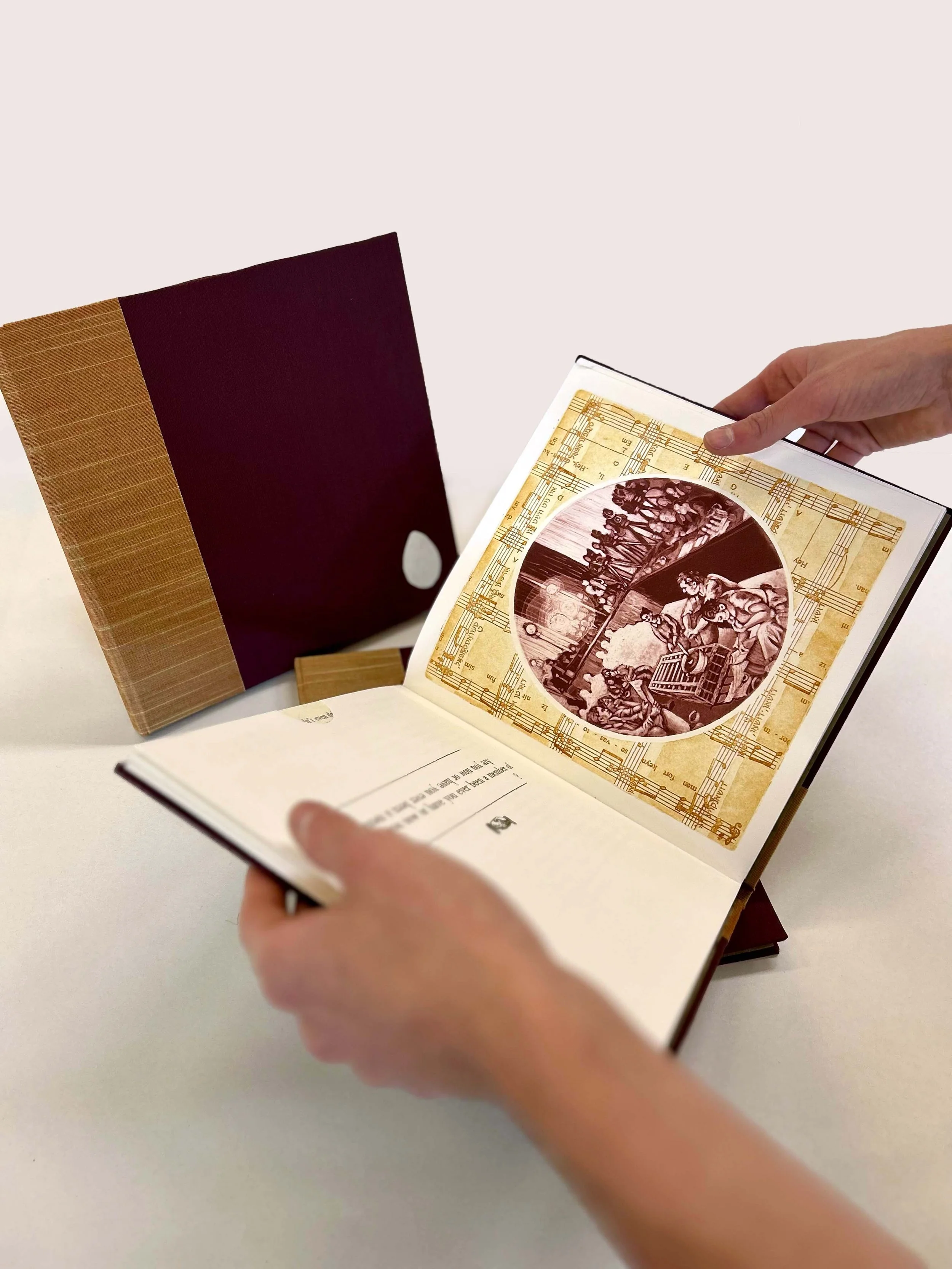
New Artist Book Release! In Der Mit, with Yael Horowitz
My beloved collaborator, Yael Horowitz, and I recently finished binding our newest artist book, In der mit. ts story took root in the specific local history of Yiddishist chicken farmers in Petaluma, CA and gestures outwards to broader narratives like the impact of McCarthyism on the Jewish left. In the process of writing and drawing and printing we tried to imagine the utopic dreaming of this community, and to look directly at the many causes of its disintegration, from without and within. Speculative writing and art-making allowed us to venture beyond a defeatist narrative of inevitable failure and imagine other possible outcomes that might inform our cultural organizing work today.
Yael and I will be sharing our fully hatched book at our workshop ‘Chicken and Egg: Which Came First, the Archive or the Story?’ This Saturday, 10:30-11:45am at the Klez Cummington Festival. If you’d like to bring a reading of In der mit to an event near you or online, please be in touch!
SECAC Conference Panel: Archival Research in Artistic Practice
The concept of “the archive” and its attendant possibilities for contemporary artists is vast – expanded by online access to institutional archives through digitization and by interventions from postcolonial, queer, and disability theory that introduce forms of communal memory preservation outside of institutions. In working in this broadly defined archival space, how do visual artists engage with or resist notions of historical “authenticity”? What is the role of what Saidiya Hartman has termed “critical fabulation” in filling in the gaps of what is left out of the archive? How are the visual arts uniquely situated to contribute to a public understanding of archival materials and the histories they carry? This session seeks papers from artists and arts educators who are drawing on archival research in their practice or designing curricula that draw upon historical primary source materials.
Co-chaired by Etai Rogers-Fett and Beauvais Lyons at the 2026 SECAC Interwoven Conference in Winston-Salem, NC.
MAPC Demo: Silk Aquatint and Acrylic Flocculation
This demo at the 2026 Mid America Print Council Conference will cover silk aquatint, a painterly collagraph technique that combines a delicate layering to build up value, reminiscent of watercolor, with a mesh covered plate that is inked up and printed. Named after the traditional etching process of aquatint, silk aquatint similarly gives artists the ability to create subtle tonal gradations between rich darks and bright whites. These plates are inked up like intaglio plates and have a remarkable ability to reproduce each expressive brush stroke. By prepping various states of the silk aquatint matrix ahead of time, I will demonstrate adhering mesh to a plastic plate, the beginning of the painting process, and pulling a proof print.
Silk aquatint has wonderful potential not only an accessible bridge between painting and printmaking, but also for adapting to the requirement or desire for a “green”, solvent-free workspace. As part of my demo, I will talk about how this process was a versatile solution for teaching printmaking to both teens and adults in classrooms with little ventilation. In terms of material impact on the planet, the primary byproduct of the process is water with acrylic paint residue. To conclude the demo, I will demonstrate the process of acrylic flocculation for filtering out acrylic paint particulates as a solid, keeping them from entering the waterways.
500 Years of Yiddish Printing Symposium
I will be attending the 500 Years of Yiddish Printing Symposium at Oxford University this October to present my paper, “Tsu shafn a nayem vort, IKRES: Printing and Self-Publishing in the Jewish Consumptive Relief Society.”
Ink and Oysyes: Printmaking for a Visual Yiddishkayt
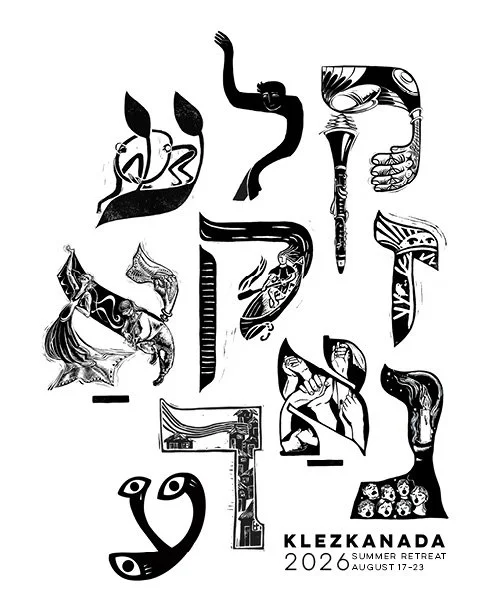
In this four-part workshop, we will look briefly at the history of Yiddish typography in print and how artists have playfully expanded the expressive visual language available to us in yidishe oysyes. Drawing inspiration from these examples, class participants will work together to create a hand-carved, relief-printed alef-beys banner. Class instruction will cover the basics of composition design, block preparation, image-transfer, and carving and printing techniques. Participants can expect to come away with new skills and ways of relating materially to the alef-beys, paper proofs of their print, and a carved block to continue printing at home. Basic knowledge of Yiddish can be helpful, but is not required.